Why the UK has no incarceration number
A short story about a deliberate blank: the UN reports prisoners for England & Wales, Scotland and Northern Ireland separately — and we won't invent a UK total.
On this page
Open the United Kingdom's page on this site and go through the measures. Life expectancy: there. Homicide: there. Incarceration: missing. The UK is one of the most data-rich countries on Earth, our source for prisoner numbers covers well over 200 countries and territories — and yet, no UK row.
It's not a bug. It's the site's data policy doing its job, and it makes a nice small case study in why blanks exist.
One country, three prison systems
Our incarceration figures come from the UNODC — the UN Office on Drugs and Crime — which compiles how many people each jurisdiction holds in prison per 100,000 residents.
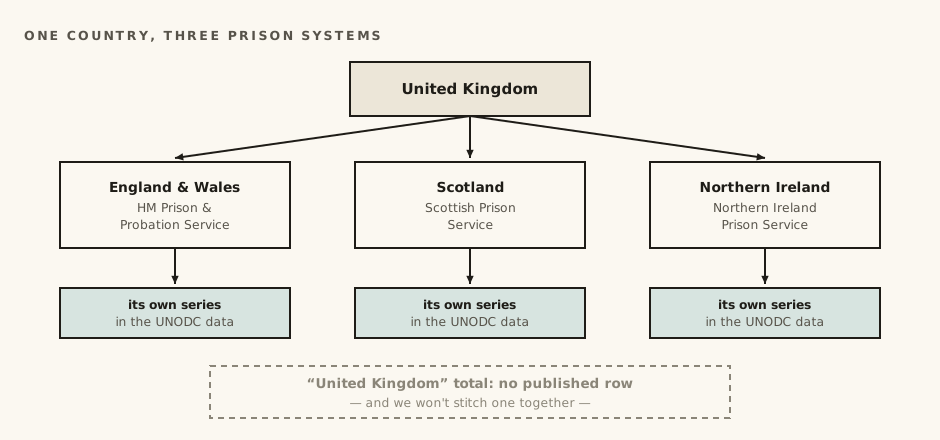
The United Kingdom, as far as prisons are concerned, is not one jurisdiction. England & Wales run one prison system, Scotland another, Northern Ireland a third — separate services, separate law, separate statistics. England & Wales, Scotland and Northern Ireland each publish their own accredited series. So that is how the UK reports to the UN, and that is how the UNODC publishes it: three series. Even the World Prison Brief, the standard reference on prison populations worldwide, lists the UK as three separate jurisdictions. There is no "United Kingdom" row in the dataset our pipeline reads, because the UK, institutionally, doesn't have a single prison statistic.
Couldn't you just add them up?
Arithmetically? Sure. Take each jurisdiction's prisoners, add them, divide by the UK population, and you'd get a plausible-looking rate. Plenty of publications do exactly this.
We don't, because of the rule the whole site is built on: every number here must exist in an official published dataset. A self-assembled UK figure would be our estimate wearing a UN badge. It would mean quietly making the judgment calls a publisher normally makes and documents — whether the three reference dates align, whether each series counts remand prisoners the same way, which population estimate to divide by. Each call is small; together they produce a number nobody published and nobody but us could check.
For a site whose entire pitch is "click any number and verify it at the source", that trade is a bad one. A blank is checkable. A stitched-together number is not.
What you can still see
The incarceration ranking works fine for everyone the UNODC does publish whole.
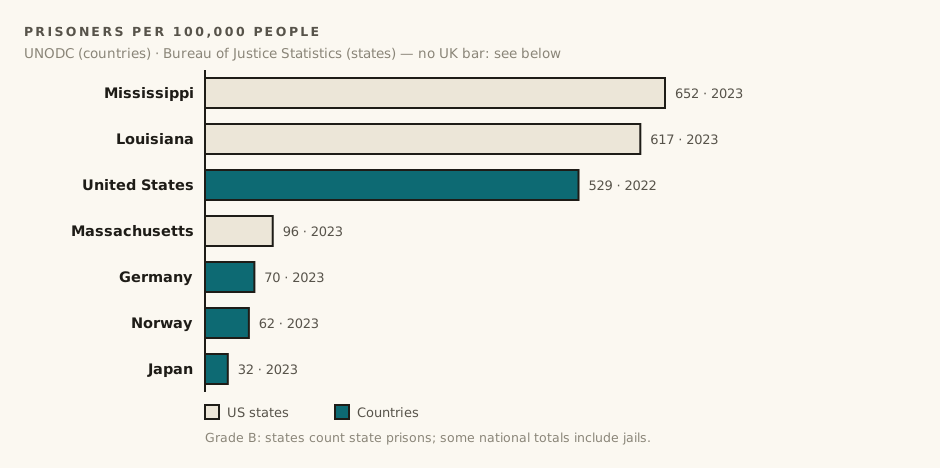
A few figures from our current data, per 100,000 people: the United States at 529 (2022) — with states ranging from Massachusetts at 96 to Louisiana at 617 and Mississippi at 652 (2023) — against Germany at 70, Norway at 62, and Japan at 32 (2023). The state side comes from the Bureau of Justice Statistics, which has collected prisoner counts since 1926.
Even here a caveat rides along, printed on the measure: US state figures count state prisons, while some international totals include jails and people awaiting trial. It's a grade-B comparison — directionally solid, definitionally imperfect, and labelled as such on the sources page.
Blanks are information
The UK's missing prison number is the most concrete example of a pattern you'll meet all over this site. There is no happiness figure for US states, because the survey behind it isn't published at state level. There's no state figure for pupil performance, because no defensible method links America's school tests to the international PISA scale. In each case the tempting move is the same — interpolate, approximate, stitch — and the honest move is the same too: leave the cell empty and say why.
When a site shows you a number for absolutely everything, somewhere behind the scenes, someone was stitching. A blank means: no honest number exists, and we didn't pretend otherwise.
Sources & further reading
- UNODC — Persons held in prisons (dataUNODC) — the international prison-population series we use — with England & Wales, Scotland and Northern Ireland as separate entries.
- UK Ministry of Justice — Prison population statistics — the England & Wales series at its source.
- Scottish Government — Scottish prison population statistics — Scotland's own accredited series.
- Department of Justice (Northern Ireland) — NI Prison Service statistics — Northern Ireland's own series.
- World Prison Brief (ICPR, Birkbeck) — the standard reference on prison populations worldwide — which also lists the UK as three separate jurisdictions.
- Bureau of Justice Statistics — National Prisoner Statistics — the US state prison figures on the other side of our incarceration ranking.
Every dataset behind the numbers in this post is also listed, with its retrieval date and comparability grade, on the sources page.
Frequently asked questions
Why is there no UK incarceration rate on Ranking Countries?
Because no official source publishes one. The UK runs three separate prison systems — England & Wales, Scotland and Northern Ireland — and reports three separate series to the UNODC. Even the World Prison Brief lists the UK as three jurisdictions. The site only shows numbers that exist in an official published dataset, so the UK's cell stays blank.
Couldn't the three UK prison series just be added together?
Arithmetically yes, and plenty of publications do. But a self-assembled total would mean quietly making the judgment calls a publisher normally documents — reference dates, remand definitions, which population estimate to divide by — producing a number nobody published and nobody else could check. A blank is checkable; a stitched-together number is not.
How does the US incarceration rate compare internationally?
In the site's current data, the United States holds 529 prisoners per 100,000 people (2022), with states ranging from Massachusetts at 96 to Louisiana at 617 and Mississippi at 652 (2023) — against Germany at 70, Norway at 62 and Japan at 32 (2023). It is a grade-B comparison: US state figures count state prisons, while some international totals include jails and remand.