Pinned snapshots: when we deliberately don't auto-refresh
Most of our data updates weekly by robot. Some datasets are frozen on purpose — PISA, the Yale environmental index, gun deaths and more — and reviewed by hand.
On this page
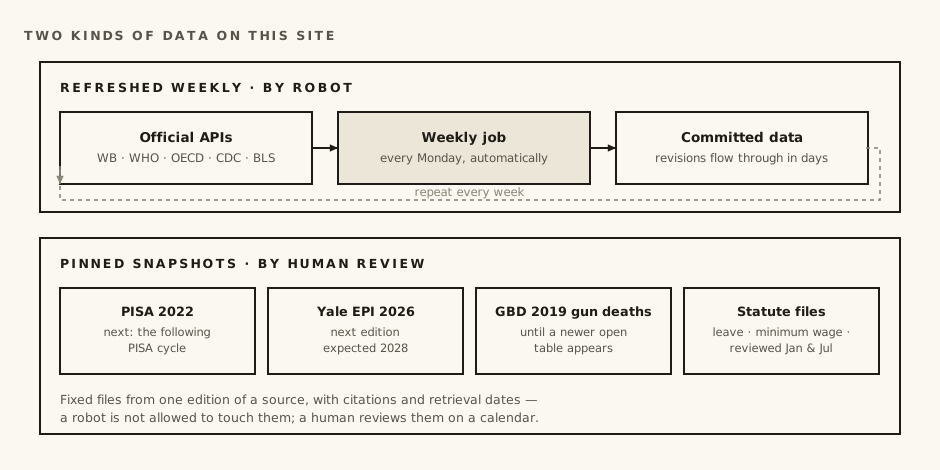
Most of the data on Ranking Countries updates itself. A scheduled job runs weekly, calls the official APIs of the World Bank, WHO, OECD, CDC, BLS and friends, and commits whatever they currently publish. If a statistical office revises a number on Tuesday, our copy follows within the week. The sources page labels these sources "refreshed weekly", with the date of the last pull.
But some of our datasets are the opposite: pinned snapshots — fixed files from one specific edition of a source, with full citations, that a robot is not allowed to touch. They change only when a human reviews them, roughly once a year. Here's why freezing data is sometimes the more honest choice.
Some data has editions, not feeds
An API-shaped worldview assumes data flows continuously. Plenty of the world's best data doesn't — it is published in discrete editions, like books.
PISA, the OECD's international student assessment behind our pupil performance measure, runs roughly every three years. Our figures are the PISA 2022 mathematics results — 81 countries and economies — and there is nothing to refresh until the next cycle's results arrive. Re-downloading weekly would just re-download the same test.
The Yale Environmental Performance Index, behind our country environment scores, ships a new edition every two years. We carry the 2026 edition, covering 177 countries; the next is expected in 2028.
For these, "is it current?" is the wrong question. The right one is "is it the latest edition?" — and that's a question for an annual review, not a cron job.
Sometimes the honest number is the older number
Our country gun deaths figures are pinned to the 2019 Global Burden of Disease study. Newer estimates exist — behind login walls and restrictive terms. GBD 2019 is the newest openly published, country-complete table of firearm deaths from all causes (homicide, suicide and accidents together), so that is what we use, clearly labelled, until a newer open table appears. We check for one every year.
Pinning it has a side effect worth knowing: the GBD figures are age-standardized, which in an aging rich country runs below the raw rate — GBD 2019 puts the US at 10.1 firearm deaths per 100,000 while the CDC's crude figure for that era is around 12. Neither is wrong; they answer slightly different questions. It is exactly the kind of print-the-caveat situation our comparability grades exist for.
Laws aren't measured — they're read
Three of our snapshots aren't statistics at all. They are facts of law, compiled by reading statutes.
Paid vacation: every US state mandates zero days of paid annual leave, so any country with a statutory minimum outranks all fifty — that's not a data quirk, it's the honest comparison. The country figures require judgment calls a robot can't make: converting six-day-week entitlements (Germany's statutory 24 days become 20 five-day weeks) and calendar-day statutes into comparable working days.
Paid maternity leave: country figures come from the OECD's family database; the state side is a hand-checked list of which state programs actually pay benefits today — including the traps, like states that enacted programs which don't start paying for years.
State minimum wages: statutes change every January and July, so this file is reviewed twice a year. There's also a practical irony here: the US Department of Labor's own minimum-wage page blocks automated retrieval, so it gets re-verified by a human, by hand. We pull data from official APIs and published files only — when a source won't serve robots, the answer is manual checking, not scraping.
The annual review
Every snapshot lives in our repository next to a README recording what it contains, where each number came from, what conventions were applied, and what to re-check at review time: new PISA cycles, new EPI editions, newly-opened GBD tables, statute changes, program start dates. Each carries its retrieval date, and that date is shown on the sources page like any other.
Why not just auto-refresh everything?
Because an auto-refreshing pipeline pointed at edition-based or judgment-based data doesn't produce fresher data — it produces silent errors. A scraper misreads a redesigned page; a "new" file turns out to be a methodology change that breaks the series; a statute gets misparsed. Weekly automation is for sources that are built for it. For everything else, the honest configuration is: freeze a well-cited copy, show its date, and put a human review on the calendar.
The test we apply to every dataset is the same either way: could a reader trace this number back to its publisher and check it? For API data, that's a link and a refresh date. For snapshots, it's a citation, a retrieval date and a documented method. Both can be trustworthy. Only one should be automated.
Sources & further reading
- OECD — PISA 2022 Results (Volume I) — the mathematics results edition our pupil-performance measure is pinned to.
- OECD — PISA 2022 Technical Report — how the assessment and its scale are constructed.
- Yale — Environmental Performance Index — the biennial index behind our country environment scores; we carry the 2026 edition.
- IHME — Global Burden of Disease results tool — the source of our pinned GBD 2019 firearm-deaths table; newer estimates exist behind login walls and restrictive terms.
- OECD — Family Database — the country side of our paid-maternity-leave measure, including indicator PF2.1 on parental leave systems.
- US Department of Labor — State minimum wage laws — the consolidated state table we re-verify by hand — the page blocks automated retrieval, so a human checks it.
Every dataset behind the numbers in this post is also listed, with its retrieval date and comparability grade, on the sources page.
Frequently asked questions
What is a pinned snapshot on Ranking Countries?
A fixed data file from one specific edition of a source — PISA 2022, the Yale EPI 2026, the GBD 2019 firearm table, hand-read statute files — with full citations, that the weekly refresh job is not allowed to touch. It changes only when a human reviews it, roughly once a year.
Why not auto-refresh every dataset?
Because auto-refreshing edition-based or judgment-based data doesn't produce fresher data — it produces silent errors: a scraper misreads a redesigned page, a "new" file turns out to be a methodology break, a statute gets misparsed. Weekly automation is reserved for sources built for it, i.e. official APIs.
Why are the country gun-death figures from 2019?
Because GBD 2019 is the newest openly published, country-complete table of firearm deaths from all causes. Newer estimates exist behind login walls and restrictive terms. The site uses the open table, clearly labelled, and checks yearly for a newer open edition. Note the GBD figures are age-standardized — GBD 2019 puts the US at 10.1 firearm deaths per 100,000, below the CDC's crude figure of around 12 for that era.
How often are the pinned datasets reviewed?
Roughly once a year, against a per-snapshot README listing what to re-check: new PISA cycles, new EPI editions, newly opened GBD tables, statute changes. State minimum wages move every January and July, so that file is reviewed twice a year.